Illustrative photo: Kanchanara / Unsplash. The coins shown are not digital balances.
A payment involves more than a coin symbol
“Bitcoin accepted” or “USDT available” sounds like complete information. But an actual transfer requires several more details: Which network is used? What is the recipient's address? Is there a minimum amount? Who pays which fee? And when is the process considered complete?
These details must match
 CurrencyCheck which coin or token the recipient accepts.
 NetworkMatch your selected network to the recipient's instructions.
 Recipient addressUse the address the recipient provides for this specific payment.
 AmountAccount for fees and minimum amounts as well as the payment amount.
These questions apply beyond casino payments. They also matter when transferring between a wallet and an exchange or paying another digital service. The difference often lies with the recipient: A self-custody wallet displays a transaction differently from a platform that first assigns incoming payments to customer accounts internally.
For gambling services, there is an additional requirement before any payment question: The specific operator must be permitted in the relevant market and available under its own terms. This guide explains technical terms and common processes. It is not a guide to bypassing country restrictions or protective systems.
The four details that belong together Currency, network, recipient address and amount. Only when all four match is the payment instruction technically complete enough to proceed. Fees, minimum amounts and acceptance rules are additional conditions.
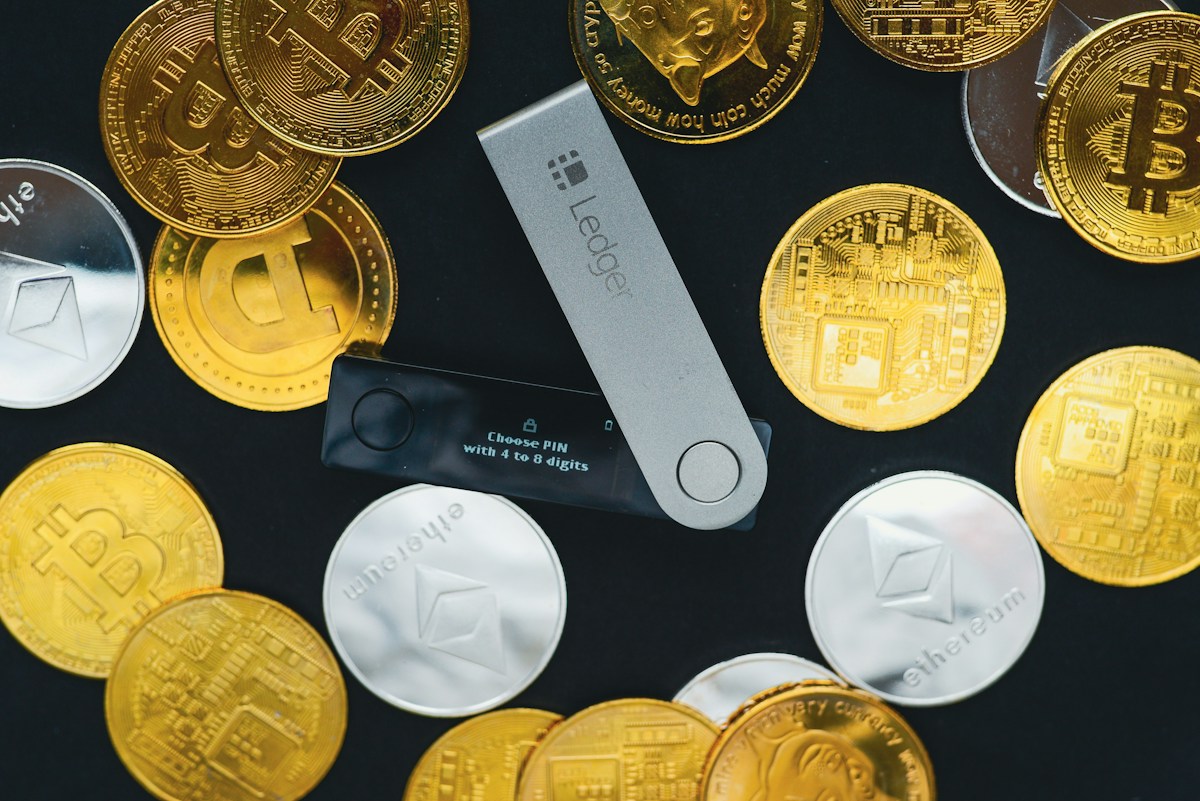
A wallet manages keys and transaction instructions. It does not replace checking the recipient. Illustrative photo: rc.xyz NFT gallery / Unsplash.
Distinguishing coins, tokens and networks
A coin or token identifies the asset being transferred. The network is the technical environment where that asset is recorded. For some currencies, this relationship seems familiar and straightforward. For others, several versions with similar names can exist on different blockchains.
USDT is a good example: Tether documents several supported protocols. For a specific transfer, the sender and recipient still need to support the same network. The existence of multiple versions does not mean a payment will arrive over any network you choose. Tether: Supported protocols
Terminology guide - not a guarantee of support by any particular provider
| Display | What it describes | What you still need to check |
|---|---|---|
| BTC | The currency name. | Which specific form and network are accepted. |
| ETH | Ether as an asset. | Ethereum Mainnet or another explicitly supported environment. |
| USDT / USDC | The name of a stablecoin. | Blockchain, token version and, where applicable, contract address. |
| ERC-20 | A technical token standard. | The specific token and the network on which it is expected. |
| Wallet address | A destination identifier in its technical context. | Whether the recipient provided this address for this specific payment. |
Why the address alone isn't enough
Addresses can look similar across different environments. A matching format does not prove that the receiving platform supports your selected token and network combination. Comparing only the first and last characters does not answer the network question.
The same applies to bridged and wrapped token versions. A similar symbol can refer to a different technical implementation. If you cannot clearly identify the version, resolve the uncertainty with the recipient before transferring. Assumed compatibility is not a sound basis for an irreversible payment instruction.
From payment request to credited funds: Each stage
A payment is easier to assess when you break the process into stages. The following overview describes a general transfer from a custodial platform to a wallet. In other setups, individual stages may have different names, but distinguishing an internal request from a network transaction remains useful.
From an internal request to available funds
- 1Request recorded
 2Review and approval
- 3Network transaction
- 4Incoming payment processing
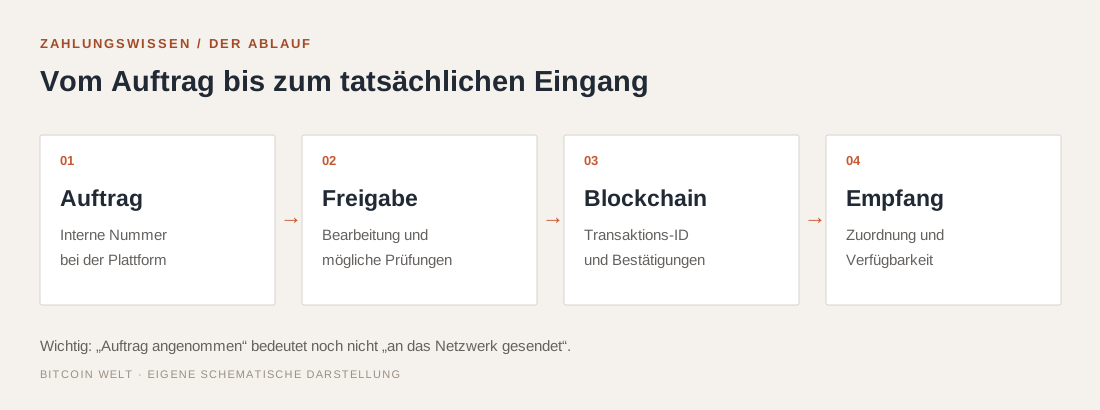
An internal reference number is not yet a transaction ID. Original schematic by Bitcoin Welt.
1. The request is created
First, the platform records the amount and destination. It may assign an internal reference number. This shows that the request exists in its system. It does not yet show that a transaction has been sent to a blockchain. A status such as “processing” may also refer exclusively to this internal stage.
2. The platform reviews and approves it
Account checks, outstanding questions or technical processes may come before sending. The applicable terms determine which checks are permitted or required. When contacting support, establish whether the request is still waiting internally or has already been sent.
3. The transaction appears on the network
Once sent, a transaction ID may be available. For Bitcoin, you can look it up in a suitable block explorer. Relevant details include its status and confirmations. A platform's internal reference number cannot serve this purpose. Blockstream: Look up transactions
4. The recipient processes the payment
After an incoming payment becomes visible on the blockchain, a receiving platform may still apply its own account-matching process and confirmation requirements. That means “visible in the explorer” and “available in the customer account” do not always happen at the same time. A precise support request identifies which of these stages has already been reached.
Which costs belong in the full calculation
“No deposit fee” describes what a particular party charges for a particular action. It does not explain all the costs of a payment. Depending on your starting point, buying, exchanging, sending and later transferring funds back may each have different costs.
| Cost type | Where it may arise | Useful comparison question |
|---|---|---|
| Purchase or trading costs | When buying cryptocurrency. | What total amount do you actually pay? |
| Spread / conversion | When converting between currencies. | What exchange rate is used compared with a verifiable reference rate? |
| Network fee | When creating a blockchain transaction. | What fee is displayed before sending? |
| Platform fee | At an exchange or another custodial service. | Is it fixed, percentage-based or dependent on the currency? |
| Return transfer | When withdrawing later. | What costs arise on the way back? |
On Ethereum, transaction costs are expressed through gas. Ethereum.org explains both the computational work and the components of the price. For a specific transaction, the current fee display therefore matters more than a blanket claim that a blockchain is always cheap. Ethereum.org: Gas and fees
For Bitcoin, the fee is not simply proportional to the monetary value transferred. The transaction's technical size and the selected fee rate play a role. Bitcoin.org explains this distinction on its fees page. Bitcoin.org: Transaction fees
CALCULATION EXAMPLE · NOT A CURRENT RATE
The net amount is what matters
Suppose €1.50 in purchase costs and €2 for sending are deducted from an initial value of €100. The calculated value received is then €96.50. This does not include further conversions or later withdrawals.
€100 − €1.50 − €2 = €96.50
For small transfers, also check the minimum amount. A theoretically low-cost route is no help if the recipient does not automatically credit the remaining amount. The amount, deductions and minimum threshold therefore belong in the same calculation.
How long does a crypto payment take?
A fixed answer in minutes would be inaccurate without more details. The total time can include internal processing, network submission, inclusion in a block and processing by the recipient. When comparing two services, first make sure you use the same starting and ending points.
“Sent after one minute” can mean something different from “available in the destination account after one minute.” Likewise, a platform that waits for many confirmations is not necessarily slow to send. Without separating the stages, technical and operational causes get mixed together.
A useful comparison therefore records at least four points in time: request submitted, platform approval, network transaction visible and incoming funds available to the recipient. Not every service provides all these details. In that case, identify the missing transparency rather than assigning a seemingly precise overall rating.
Confirmations are also a security and acceptance criterion, not a universal stopwatch. Bitcoin.org explains that the desired number of confirmations depends on the payment's acceptance context. It would therefore be wrong to present a single number as an automatic rule for every platform. Bitcoin.org: Payment FAQ
USDT and USDC: A stable reference, different risks
Stablecoins aim to maintain a peg to a reference value. This can make balances easier to display, but it does not make the entire setup risk-free. A complete assessment needs to consider the peg, issuer, technical version and custodial platform separately.
Circle identifies relevant limitations in its USDC risk disclosures. In particular, a third-party platform's support for USDC does not mean Circle endorses that platform's legality or reliability. A recognized token logo does not give the recipient a seal of approval. Circle: USDC Risk Factors
A peg to the US dollar is also not the same as a constant euro value when your budget is in euros. Comparisons should make clear which units are used for balances, fees and limits. A table that mixes dollars, euros and token amounts without labeling them creates confusion rather than clarity.
Regardless of the peg, the network question remains. The same brand name can appear on multiple blockchains. Selecting the correct network does not protect against every financial risk, but it prevents avoidable misunderstandings in the technical payment instruction.
Payment hasn't arrived: What to check first
If an amount is missing, don't immediately send a second payment. First, establish what happened to the existing transfer. The following questions provide a basis for contacting the party involved.
- Do you have an internal reference number or a transaction ID? Ask the sending service about an internal reference number. An actual transaction ID can be checked on the appropriate network.
- Do the currency and network match? Compare the payment request with the instructions the recipient provided for this transaction. A similar name or familiar address format is not enough.
- Which address was used? Record the address actually included in the payment request. Screenshots of a later form do not prove where the original payment was sent.
- Has the transaction been confirmed? Distinguish a pending network status from a confirmed transaction that has not yet been assigned internally.
- Was the minimum amount met after deductions? Check the value that reached the recipient and the applicable acceptance rule.
- Which party can actually help? Before sending, the sending service is generally your point of contact. For a confirmed payment that has not been credited internally, the receiving platform can investigate.
For a support request, the date, currency, network, amount and transaction ID are more useful than simply saying “my coins are gone.” However, publicly visible transaction data can reveal connections between addresses. Avoid unnecessarily sharing complete payment details in public comment sections.
Recovery of payments sent to an incorrect address or through an incompatible technical setup is not guaranteed. Legitimate help should not depend on sharing private keys or a recovery phrase. Unsolicited “recovery” offers are not proof that someone has the technical ability or legal authority to recover funds.
Wallet security: Which information must stay private
A wallet address may be needed to receive funds. A recovery phrase or private key is fundamentally different: It can give someone control of a wallet. Ethereum.org explicitly warns against sharing this information. Ethereum.org: Security and scam prevention
Protect your keys and check payment instructions carefully
 Protect secretsNever share private keys or your recovery phrase, even with support.
 Hardware walletCheck carefully what you approve: The device does not replace this review.
 Secure your loginUse an additional authentication factor; check payment destinations separately.
This creates a clear boundary for support conversations. A representative may ask for a transaction ID or the network involved. Asking you to enter your secret recovery phrase into a form is not comparable. A professionally designed chat or a familiar-looking profile picture does not change what this information can do.
A hardware device can separate key management from ordinary online access. But it does not replace carefully checking what you approve. MetaMask's help documentation explains this distinction and states that secret recovery information must remain private, even from supposed support representatives. MetaMask: Basic security guidance
For a platform account, access to your email address also matters. An additional authentication factor can protect your login better than a password alone. But it does not fix an incorrect payment destination or establish whether the platform operator is reliable. Account security and transaction checks are complementary tasks. Cloudflare: Two-factor authentication
Checklist for assessing a payment service
The following list is a research aid. You can also use it to compare providers' public information without opening an account or making a transfer.
- Is the service intended for the relevant country and permitted there?
- Are the operating company and actual domain clearly identified?
- Are the currency and network named separately?
- Is the exact token version documented?
- Are the minimum amount and fees clear?
- Is internal processing distinguished from blockchain submission?
- What information is available about verification and limits?
- Is there an accessible complaint or support channel?
- Is a transaction ID provided after sending?
- Are screenshots and statements identifiable as current or historical?
A single missing detail does not automatically prove misconduct. But it is an open question that should be answered before reaching a well-supported assessment. Conversely, an extensive help section does not make a provider reliable. Research and practical experience address different parts of the same investigation.
Sources for further reading
The examples are independent hypothetical calculations. They do not claim to show current network fees or guaranteed transfer times. Research current as of November 6, 2026.
- Bitcoin.org: Essential basics
- Bitcoin.org: Fees
- Ethereum.org: Gas and fees
- Tether: Supported protocols
- Circle: USDC risks
- Blockstream: Look up transactions
- Ethereum.org: Wallet security
Frequently asked questions
Why is USDT available on different networks?
The issuer documents several technical protocols. For any particular transfer, the sender and recipient still need to use the same supported version.
Is a transaction ID the same as an order number?
No. A service can assign its own internal reference number before a network transaction exists. A transaction ID identifies a specific transaction on the relevant blockchain.
Why hasn't a confirmed payment been credited?
A receiving platform may have its own confirmation requirements and internal processes for assigning payments to accounts. Include the network, amount and transaction ID when contacting support.
Can I always cancel an incorrect transfer?
No. Don't assume you can reverse an executed payment as easily as editing a form. Bitcoin.org explains why payments require particular care. Bitcoin.org: Essential basics
Should I send support my recovery phrase?
No. A recovery phrase can give someone control of your wallet. It is not a normal payment receipt and should never be shared with someone claiming to be a support representative.